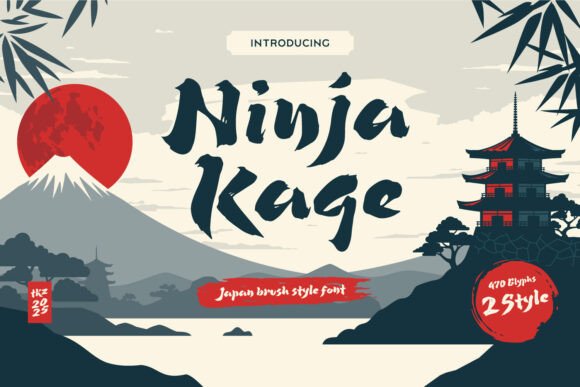
Ninja Kage: The Brush Font That Blurs the Line Between Digital and Handmade
There's a particular kind of magic in a font that makes people lean in closer. You've seen it before — a logo, a movie poster, a book cover — and something about the lettering feels alive, like someone just set down a brush and walked away. Ninja Kage is that kind of typeface. It's a dynamic brush font rooted in Japanese calligraphy, and its whole purpose is to make viewers wonder whether they're looking at carefully crafted lettering or actual handwriting.
That question — "Is this a font or did someone really write this?" — is exactly where Ninja Kage draws its power. For designers, brand builders, and creative professionals who need their work to feel human, warm, and intentional, this font delivers something that most display fonts simply can't: genuine character.
What Makes Ninja Kage Look and Feel So Convincing
The secret is in the details. Ninja Kage doesn't just mimic brush strokes — it captures the rhythm, pressure variation, and organic flow of real calligraphy. Every letter carries subtle irregularities that feel natural rather than mechanical. The strokes taper where they should, thickening and thinning the way a loaded brush behaves against textured paper. This isn't the sterile, uniform output of a standard script font. It breathes.
What really pushes Ninja Kage into convincing territory is its extensive library of alternates and ligatures. These are alternate versions of letters and natural connections between them that activate depending on context. The result? No two words look exactly the same. When you set a headline or a logo in Ninja Kage, the letterforms shift and connect in ways that mimic how a human hand would actually move across a surface. That variation is what sells the illusion.
The font ships in two styles: Regular and Rough. The Regular style offers a clean, confident brush look — bold enough for logos and titles, polished enough for branding materials. The Rough style introduces more texture, grit, and imperfection. It feels aged, weathered, like something pulled from a vintage martial arts film poster or a hand-painted shop sign. Having both styles gives you flexibility depending on the mood and context of your project.
Where Ninja Kage Earns Its Place in Your Design Toolkit
Not every font earns a permanent spot on your system. Ninja Kage justifies itself across a surprisingly wide range of applications, and understanding where it excels helps you use it with intention rather than impulse.
Branding and Logo Design
A logo needs to communicate personality in a split second. If your brand identity leans toward the artisanal, the bold, the culturally inspired, or the adventurous, Ninja Kage can anchor your visual language. It works particularly well for brands in fitness, martial arts, streetwear, craft beverages, independent food brands, and any business that wants to project strength with authenticity. The key here is restraint — use Ninja Kage for the primary logotype and pair it with a clean sans serif font for body text and supporting information.
Editorial and Publishing Design
Book designers and publishers often struggle with the same tension: how to make a cover feel distinctive without resorting to gimmicks. Ninja Kage solves this for genres like thriller, action, historical fiction, manga-inspired publications, and lifestyle books. Its brush energy creates immediate visual hierarchy on a cover, pulling the eye to the title while establishing tone. For interior chapter openers, it can work at smaller sizes if you lean on the Regular style and test readability carefully.
Digital and Social Media
In the fast-scrolling world of social media graphics, you have about one second to grab attention. A headline set in Ninja Kage carries visual weight and personality that a standard sans serif simply can't match. It's effective for YouTube thumbnails, Instagram story headers, podcast artwork, and promotional banners. On the web, it works beautifully as a hero section headline or a call-to-action accent — places where you want emotion and impact rather than long-form readability.
Game Design, Posters, and Packaging
This is arguably where Ninja Kage feels most at home. Game titles, movie posters, event flyers, and product packaging all demand typefaces that carry narrative weight. The font's Japanese calligraphic roots give it a cinematic, almost mythic quality. For packaging design — especially in food, beverage, or cosmetics — it can add a handcrafted, premium feel that signals quality and care to the buyer.
How the Right Font Shapes Perception and Engagement
Typography isn't decoration. It's communication. The typeface you choose for a project directly influences how your audience perceives the content, the brand behind it, and the level of professionalism on display. This is where understanding fonts like Ninja Kage becomes a practical skill rather than an aesthetic preference.
Visual hierarchy depends on contrast. If everything on your layout uses the same weight and style, nothing stands out. Ninja Kage, as a premium display font, naturally commands attention in headlines and focal points. Pairing it with a quiet, neutral serif font or a geometric sans serif for supporting text creates a clear reading path — the eye knows exactly where to go first.
Brand perception shifts dramatically based on typeface choice. A handwritten font like Ninja Kage signals craft, individuality, and human presence. It tells your audience that a real person is behind this brand, not a committee. For small business owners and entrepreneurs building a personal brand, that signal is invaluable. It builds trust faster than any stock template ever could.
Audience engagement increases when design feels intentional and emotionally resonant. People linger on things that feel alive. Ninja Kage's organic letterforms create that magnetic quality — especially in contexts where most competitors rely on overused Google Fonts or generic commercial fonts that everyone has seen a thousand times.
Practical Guidance for Working With Ninja Kage
Choosing a creative font is only half the equation. Using it well is where the real work happens. Here are some grounded recommendations for getting the most out of Ninja Kage in your projects.
- Test font pairings before committing. Set Ninja Kage alongside several candidates — a clean sans serif like Montserrat or Inter for modern projects, or a classic serif like Playfair Display for editorial work. Look at how the x-height, weight, and personality interact. The best font pairing feels balanced, not competing.
- Review both styles in context. Don't just preview the Regular style in isolation. Drop both Regular and Rough into your actual layout with real copy. The Rough style might surprise you — it can work beautifully in contexts where you initially assumed it would feel too raw.
- Respect readability boundaries. Ninja Kage is a display font, not a body text font. Use it for headlines, logos, short phrases, and accent text. For paragraphs, product descriptions, or anything longer than a sentence or two, switch to a legible serif or sans serif. This isn't a limitation — it's how good typography works.
- Check the commercial license. Before using Ninja Kage in client work, merchandise, or products for sale, confirm the licensing terms. Most premium fonts offer different license tiers for personal, commercial, and extended use. Protecting yourself legally is part of professional design practice.
- Explore the alternates intentionally. Don't just install the font and use default settings. Open your design software's glyph panel and browse the alternate characters. Swapping in a different "a" or "t" can transform the feel of a word. This is where Ninja Kage's depth really shows.
Ninja Kage isn't trying to be everything. It knows exactly what it is — a bold, expressive, human-feeling brush typeface built for moments that demand personality. Used thoughtfully, it becomes one of those design assets you reach for again and again, not because it's trendy, but because it consistently makes your work feel more alive.